Friday, 16 October 2015

Forshadowings: Religious Gothic and 'The Monk' by Matthew Lewis


Last week, Sheffield Gothic had its first meeting of the new semester, screening the 1947 film Black Narcissus, based on Rumer Godden's 1939 novel of the same name. It was a brilliant film about madness and desire in an isolated convent full of troubled nuns. Afterwards we discussed surveillance within convent life and how the film's gendered and political discourses reflected the post-WWII world. Mental illness and the resurrected and returned past were also important elements discussed in a Gothic context. Most notably, the unusual aesthetic of the piece made it stand out among the other Gothic materials we've read and watched – rather than depicting shadows and obscurity, this film was shot in a stark and bright yet dream-like space on the top of a mountain, and numerous characters complain of being able to see to much of themselves and their surroundings rather than too little. 

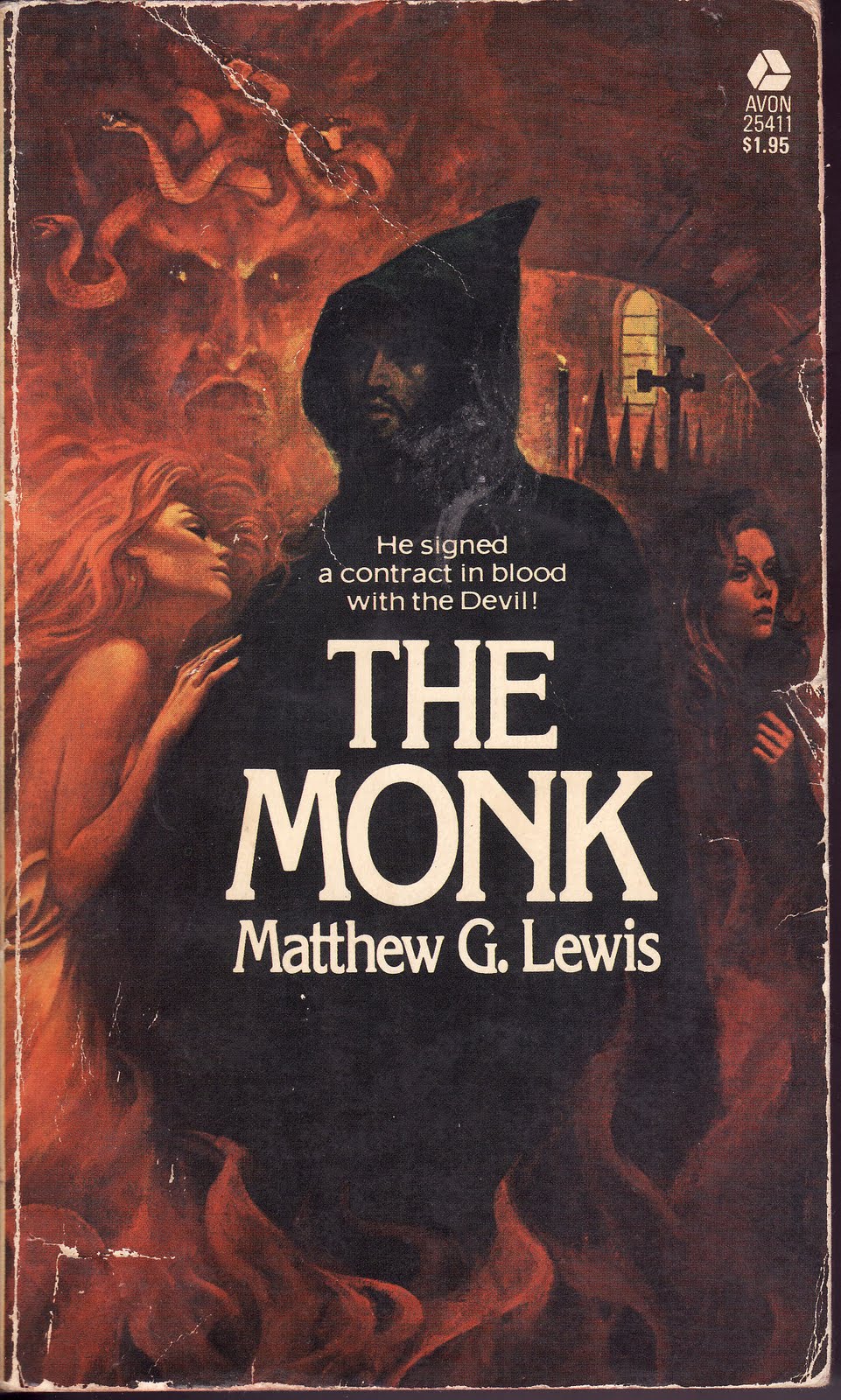
 In our next reading group meeting we will be going back to the early Gothic genre to discuss Matthew Lewis’s infamous 1796 novel The Monk. This work employs a more traditional Gothic aesthetic and is considered a formative text among Gothic students. The story follows a troubled, repressed monk as he struggles within a hypocritical system of morality and eventually falls prey to demonic forces.

Early Gothic novels are particularly relevant to our semester's 'Religious Gothic' theme (plus the novel is named 'The Monk' so... there's that). The first examples of Gothic novels emerged during a time when many British authors were trying to redefine their of national literary identity. One of the strategies for this was aligning ‘Britishness’ and national identity with a Protestant morality as opposed to a Catholic (French / Italian) 'otherness' and a pre-Enlightenment preoccupation with superstition. For example, heroines in Ann Radcliffe’s novels, while ostensibly foreign, represent an ‘English’ / Protestant belief system which finds itself trapped in a dangerous, alien, and nominally Catholic culture. The heroine's evolving 'sensibility' suggests a rational emotional intelligence which rejects a blind belief in the supernatural and the corresponding inability to respond maturely to 'terror'.

 
"...and this one time, at band camp..."
"Please stop..."

Matthew Lewis wrote The Monk as a response to, and a deviation from, Radcliffe's work, and in keeping with his 'masculine' Gothic style tends to be more preoccupied with overt ‘horror’ than the nuances of ‘terror.’ Maggie Kilgour argues that “Lewis presents himself as the complete revealer, who takes all of the terrors that Radcliffe leaves submerged and exposes them, turning gothic potentials into reality” (The Rise of the Gothic Novel, 142). He creates worlds where identity is fluid and anything is possible, and as such established institutions and religious and political and class identities are destabilized, exposed as inadequate, hypocritical, or corrupt. Rather than advocate for one religion or national discourse over another, Jacqueline Howard argues that Lewis uses discourses of sublimity to “describe a world in which there is no universal rational and moral order” (Reading Gothic Fiction, A Bakhtinian Approach, 219). Such narrative is a significant Gothic alternative suggesting a libertine discourse which sees all institutions, including religious institutions as represented by monastic hierarchies, as inherently problematic.

As such, organized religion becomes the mechanism through which Gothic monsters and grotesques are made. The titular monk Ambrosio's better traits are twisted within a repressive monastic system, leaving him open to seduction by a demonic temptress. A man attempts to elope with his love despite her commitment to become a nun. He is later entrapped by the ghostly ‘Bleeding Nun,’ who drains him of life and is only banished by the intervention of the ‘Wandering Jew.’  A prioress of a convent attempts to murder deviant nuns, a monastery tomb becomes the scene of a horrific rape and murder, and ultimately both the monastery and convent are destroyed by a raging mob.

Still... beats the morning commute! Am I right? Anyone...?

By the time we learn that one overbearing mother character has forbidden her daughter from reading the Bible - “ convinced that, unrestricted, no reading more improper could be permitted a young woman, and that “the annals of a brothel would scarcely furnish a greater choice of indecent expression” - one is, surprisingly, forced to concede some truth in the mother's ironic fears (Lewis, 191). Most of the text up to that point has suggested that religion nurtures vice and corrupts virtue, at best failing to provide an adequate moral compass, at worst imposing arbitrary restraints and denying free human emotion with mortal consequences. 

But is the novel really that straightforward? What is Lewis really trying to say about organized religion? How do religious tropes define the characters and their actions? How does Lewis use religion to construct the 'Gothic,' and how does the 'Gothic' influence our understanding of religion and identity? 

Come to Gothic reading group for more discussion, cake, and death! We'll be meeting on October 21st, 4-6 pm, and the University of Sheffield (JW, Hub 2).  Follow us on Twitter @SheffieldGothic for more updates!


Kathleen Hudson is a final year PhD student studying servants in early Gothic literature at the University of Sheffield. She has a desk Cthulhu...and it's adorable.

Wednesday, 14 October 2015

Review: 'The Rise, Fall, and Rise of the Cthulhu Mythos' by S. T. Joshi


To understand The Rise, Fall, and Rise of the Cthulhu Mythos, we must consider previous book-length treatises on the work and legacy of H. P. Lovecraft. In 1972, Lin Carter published Lovecraft: A Look Behind the Cthulhu Mythos, which was a weak, but nevertheless charming, discussion of Lovecraft’s influence. However, Carter’s work was marred by his devotion to the specious theories of August Derleth, friend to and publisher of Lovecraft, which were ascendant at the time. Although Carter’s views on the Cthulhu Mythos went out of fashion along with Derleth’s, it would be decades before anyone sought to assess the genre in another book-length work.

 
Lost in the Cthulhu Mythos

Enter S. T. Joshi’s The Rise and Fall of the Cthulhu Mythos (Mythos Books, 2008), which was the culmination of much wide-ranging reading and thought on the subject of the Cthulhu Mythos – a genre which grew (perhaps parasitically) out of Lovecraft’s work. An insightful tirade on what is wrong with a popular genre, Joshi’s The Rise and Fall was a critical attack on the common structures found within weird fiction since the 1920s. In brief, Joshi critiqued the manner in which authors of the Cthulhu Mythos deviated poorly from the principles espoused within what he termed “the Lovecraft Mythos”, and suggested that the genre that followed Lovecraft had largely come to an undignified end.

In 2012, John D. Haefele published A Look Behind the Derleth Mythos, which served as a follow-up to Carter’s and Joshi’s texts. The book, which was published in a revised and expanded form in 2014 by The Cimmerian Press, was one of the few times that anyone has put forward extensive support and analysis of August Derleth’s theories since the 1970s. Haefele took especial umbrage with Joshi’s arguments, most notably those levelled in The Rise and Fall, and challenged those arguments to greater and lesser success throughout. Although there was much of interest in Haefele’s work, it would be an understatement to say that it has not been well regarded within weird fiction criticism.

Recently, Joshi has published a revised and expanded text titled The Rise, Fall, And Rise of the Cthulhu Mythos (Hippocampus Press, 2015). Joshi’s purpose for writing this new version seems clear: he wants to address “the extraordinary burgeoning of Mythos writing that has occurred in the past decade” (8), and he wants to rebut Haefle’s criticisms. Unfortunately, the expanded sections of The Rise, Fall, and Rise do not amount to anything particularly weighty. To get Haefle out of the way, Joshi has added ten pages to his sixth chapter, which is specifically concerned with the additions and obfuscations August Derleth put upon Lovecraft’s work. Although Joshi addresses at least some of Haefle’s concerns, it must be said that Joshi seems unnecessarily pejorative throughout this section, which threatens the weight of his criticism. Somewhat oddly, the sources for The Rise lists only the 2012 edition of Haefle’s book; however, Joshi’s introduction is dated to 2014, suggesting that he simply was not aware of Haefle’s expanded text during composition.


In the tenth and final chapter of the book, “Resurgence” (which is unique to this edition), Joshi addresses new Mythos writing. However, some (albeit only a minority) of the chapter is made up of the same material found in the ninth chapter of his earlier edition. As elsewhere, Joshi claims to use “widely accepted literary principles” (12) to render judgment on the various works up for examination in this chapter, but I fear that he rarely does the actual legwork of showing how or why a work is or is not worthy of our attention – and this lack of a central aspect of literary criticism is, I think, the biggest flaw in Joshi’s otherwise impressive oeuvre. Too often, Joshi descends into hyperbolic expressiveness in order to convince us that a given work is not all it could be (as when he begins summarizing the plot of Basil Copper’s The Great White Space with “To make a long, tedious, boring story short” [282], without demonstrating why the novel is overly long, what makes the plotting tedious, or why the prose is boring), and this hampers his impact. Strangely, Joshi is just as hyperbolic about his own The Assaults of Chaos (Hippocampus Press, 2013), which, while not as excellent as his scholarly work, is nevertheless an entertaining novel.

I am ultimately uncertain as to why this book exists. The light revisions of both text and citations throughout (citations of Lovecraft’s revision stories strangely refer to an anthology that has not yet been released), and the addition of no more than perhaps fifty pages of new material, hardly seems worthy of issuing a second edition of what was a flawed, but still noteworthy, book. Joshi has not substantively changed his opinions, after all; he still dislikes pastiches of Lovecraft’s work, he still believes that there are some few worthy contributions to the Cthulhu Mythos being made, and he still believes that August Derleth should be written out of the history of Lovecraftian fiction. Both the 2008 and 2015 edition of Joshi’s text rests on these conclusions, and a few dozen new pages on new fiction and old criticism does not, it seems to me, justify a whole new issuing of the text.

If one is unable to locate a copy of the physically superior hardcover Mythos Books version of The Rise and Fall of the Cthulhu Mythos, or if one is a scholar or collector of this sort of criticism, then by all means pick up the softcover Hippocampus Press The Rise, Fall, and Rise of the Cthulhu Mythos. But if one already has a copy of the 2008 edition, I cannot in good conscience recommend paying $25 USD for what is little more than a reskin of an edition that is less than ten years old. Make no mistake: Joshi is, indeed, the pre-eminent Lovecraft scholar, and a keen critic of weird and horror fiction in general. But here he is in essence repeating what he has already said before.


Dr. Géza A. G. Reilly has been an avid reader and collector of all things Lovecraftian since he was too young to know better.  Géza received his doctorate in English literature in 2015 and is, to his knowledge, the only scholar of weird fiction ever produced by the University of Manitoba.  An expatriate Canadian, he currently lives in Tampa, Florida with his wife, Andrea, and their cat Mim.

Monday, 12 October 2015

Review: 'Lovecraft & a World in Transition: Collected Essays on H. P. Lovecraft' by S. T. Joshi


Greeting Goths! In preparation for the Manchester Gothic Festival starting next week (See the full program at: https://www.hssr.mmu.ac.uk/gothicmmu/gothic-manchester-festival-2015/) we thought we'd celebrate one of our favorite weird fiction authors in keeping with the Festival's theme: "What Lies Beneath?" H.P. Lovecraft is an author who wrote extensively about the horrors that lurk beneath the surface, and we'll be looking at some academic and non-academic approaches to reading his work.

Guest blogger Dr. Géza Reilly has kindly reviewed four works of criticism on H.P. Lovecraft, and we will be posted them throughout the next two weeks in addition to our regular group work.  Enjoy!


Locating and acquiring secondary source material can be a chore for scholars of weird fiction, as it can be for specialists of any genre whose academic cachet is only just starting to find its foothold. The vast majority of the most important scholarly work on the weird has been published in small-press amateur or fan magazines (Crypt of Cthulhu, Nyctalops, Lovecraft Studies, Studies in Weird Fiction, etc.), most of which are long out of print and whose individual issues now constitute collector’s items. Thankfully, some of the pioneers of weird fiction criticism have seen fit to anthologize their harder-to-find works. Donald R. Burleson, for example, has recently issued his Lovecraft: An American Allegory (Hippocampus Press, 2015), and S. T. Joshi has collected the vast majority of his critical articles on H. P. Lovecraft in Lovecraft and a World in Transition through Hippocampus Press.

Neither Lovecraft nor Joshi should require much of an introduction. Lovecraft (1890 – 1937), from Providence, Rhode Island, was a seminal figure in early American weird fiction, and is currently one of the most important figures in modern fantastic literature. Joshi is often referred to as the “pre-eminent Lovecraft scholar”, although I feel that it is short shrift to limit his achievements to one literary domain. Nevertheless, Joshi is one of a handful of scholars who has worked since the early 1970s to both reintroduce Lovecraft to the world, and subject his work to rigorous academic criticism. The forty years of Joshi’s work shows in Lovecraft and a World in Transition, which comes in at 645 pages (including sources and index), and the range of his investigation into Lovecraft’s life and work are showcased admirably by this anthology. The only exclusions are, according to the author, Joshi’s reviews about Lovecraft (collected in the 2009 Classics and Contemporaries), “some inferior or ephemeral essays” (Joshi, 9), and, a bit strangely, all of Joshi’s work for the New Lovecraft Collector.

Rather than organizing his articles in order of publication, Joshi has used thematic groupings, ranging from the first, “Biographical Studies”, to the sixth, “On Lovecraft’s Legacy and Influence”. While this style of grouping makes consultation of the various essays simpler, it also means that certain insights into Lovecraft and his texts are repeated in a relatively small page range. The vast majority of these articles are substantive in their critical acumen, even when they only span a handful of pages, which attests to the devotion Joshi has given to his subject. It seems odd, however, for Joshi to have included the essay “The Cthulhu Mythos”, which is a short version of the expanded 2008 project The Rise and Fall of the Cthulhu Mythos (reprinted in August, 2015 as The Rise, Fall, and Rise of the Cthulhu Mythos). One would think that the space could have been used for another of Joshi’s works.


The critical style employed by Joshi throughout does not range farther than biographical criticism and textual studies, which should be no surprise to anyone familiar with Joshi’s academic writing in general. Atomistic analysis of Lovecraft’s work is rarely present, and most of Joshi’s insights hinge on elements drawn from Lovecraft’s biography rather than individual texts themselves. This is not, it should be said, a poor analytic choice on Joshi’s part, but it does cause some moments of consternation (such as in “The Dream World and the Real World in Lovecraft”, where Joshi’s somewhat strained judgments of a set of Lovecraft’s stories could be relieved if he were to set aside the man and focus on the work for a moment). All in all, however, Joshi is obviously most comfortable with these two critical approaches, and at his best he shines at both (the articles “Textual Problems in Lovecraft” and “A Guide to the Lovecraft Fiction Manuscripts at the John Hay Library” are standout examples of Joshi’s rigor at textual studies).

Physically, Lovecraft and a World in Transition is well arranged and presented. Hippocampus Press is known for the quality of their publications, despite being a small press, and that dedication shows here. The binding is tight, with good quality paper, and the cover is graced with an original photograph of Lovecraft (courtesy of Dan Lorraine). An obvious amount of time was spent preparing Joshi’s articles in the best possible manner, with revised citations and new footnotes bringing each essay up to date with current scholarship. In my reading I discovered one typo (a misused comma that truncated a short word), but realized that an entire article – “The Lovecraft Centennial Conference: Concluding Address” – is listed in the “Sources” section without being present in the body of the text. The title is currently sold through the Hippocampus website and the Amazon marketplace, retailing $65 USD for hardcover and $35 USD for softcover. Ebook versions will be available, but are disabled at the time of this writing.

Many of the works of the pioneers of weird fiction criticism contain invaluable insight for modern critics of the genre. Each of the articles by these titans in the field represent an immense amount of labor and passion, and each helps form the solid foundation upon which we latter day critics blithely walk. It is sad that so many of them have been allowed to almost entirely disappear from the marketplace of ideas without comment, and we devotees are left at a profound disadvantage by not having ready access to an incredible number of scholarly pieces. How lucky we are, then, that some of the aforementioned titans have decided to republish decades of work in a readily accessible manner. The scholarship of S. T. Joshi, as represented in Lovecraft and a World in Transition, may not represent the cutting edge of criticism, but none can say that we do not owe him a great debt. Lovecraft and a World in Transition offers incredible insight into one of the greatest writers of the Twentieth Century, and even greater insight into the ongoing career of one of the best critics of the fantastic to ever live.


Dr. Géza A. G. Reilly has been an avid reader and collector of all things Lovecraftian since he was too young to know better.  Géza received his doctorate in English literature in 2015 and is, to his knowledge, the only scholar of weird fiction ever produced by the University of Manitoba.  An expatriate Canadian, he currently lives in Tampa, Florida with his wife, Andrea, and their cat Mim.

Friday, 2 October 2015

Forshadowings: ‘No Place for a Nunnery’: the Powell and Pressburger’s Sublime "Black Narcissus"

On asking my tutorial group ‘what makes Wuthering Heights a Gothic novel’, I rediscovered just how much the popular conception of the Gothic is rooted in aesthetics. Ghosts were mentioned, someone touched on morality – but the dead giveaway, the ultimate indicator of Gothicness, was the setting. As a Gothic scholar, and one who is principally interested in its 20th century manifestations, I often forget just how recognizable the original incarnations of the genre are by their gloomy landscapes, supernatural chills, and labyrinthine castles. The Gothic I deal in generally tends towards a far more quotidian setting. Perhaps one exception to this general rule, however, is my prevailing obsession for the past three years with Powell and Pressburger’s 1947 film, Black Narcissus.

Adapted from a 1939 novel by Rumer Godden, Black Narcissus follows a group of Anglican nuns who are sent to establish a new convent in an abandoned harem on a precipice in the Himalayas. Doomed from the start, the sisters are increasingly plagued by memories from their pasts and their newly appointed Superior, Sister Clodagh, quickly begins to lose control of her order – particularly when confronted with the increasing madness of Sister Ruth. Dominated by themes of paranoia, sexual jealousy, madness, and transgression, it is not difficult to trace the strains of Gothic melodrama that permeate Black Narcissus. But if crumbling piles and their bleak surroundings are so definitive of the genre, the bright and airy set pieces that characterize this film (and the novel it is based on) create an interesting challenge to the common conception of the Gothic landscape.

"The hills are alive with the sound of... uh oh..."

Yes, Black Narcissus does have an abandoned palace in an exotic location, populated with nuns on the brink of madness (another Gothic favourite). However, one of the most memorable qualities of the Powell and Pressburger film is just how bright everything seems. Perhaps this is the most surprising thing about it, given how darkly Gothic is subject matter is. The Palace and its exotic environs are suffused with brightness, emphasised even more by Technicolour cinematography, and permeated by the cold winds from the mountains which blow through it. With whitewashed walls and open, airy interiors, the setting seems to consistently be at odds with the predominant image of the Gothic locale as a site of thunderstorms and dark, claustrophobic passageways.

Instead, I would argue that the setting of Black Narcissus and the pervasive sense of fear that the film grapples with is connected more closely with a different facet of the Gothic genre and its origins in the Romantic period – the experience of the sublime. The sublime in nature is akin to the sensation of terror in the Gothic novel – it is a mixture of fear and awe; a simultaneous drawing towards and pulling back of the beholder. The mountains which surround the fateful convent of St Faith’s in Black Narcissus are a prime example of the natural sublime and the distress that this exposure to the elements causes the nuns is, arguably, the primary cause for the turmoil that ensues. ‘I couldn't stop the wind from blowing, and the air from being as clear as crystal, and I couldn't hide the mountain’, the hitherto admirably stoic Sister Clodagh wails to Mr Dean as everything she has worked for begins to slip from her grasp. Her desire but inability to control that which is, by its very nature, uncontrollable represents the beginning of the end for the Sisters. 

Creepy convent and/or a lair for James Bond villains
 
But more than this, the setting beyond the convent’s boundaries also operates as a means of bringing to the surface long repressed memories and illicit desires. As Mr Dean says, “There is something in the atmosphere that makes everything seem exaggerated”. Although this is perhaps more easily recognisable in Godden’s novel, traces remain in the film that link the sublime landscape to the amplification of the nuns’ defining characteristics. While the novel discusses this in a more subtle manner, the adaptation goes straight for a post-war raw nerve and is chiefly concerned with anxieties over the transgressive, over-sexed female. Sister Clodagh’s flashbacks and Sister Ruth’s final descent into madness bring this subject to the forefront of the film. Ruth may be problematic before her arrival at Mopu, but the exaggerating effects and maddening sublimity of the mountains crystallize her repressed desires and cause them to burst forth in a one of the most memorable breakdowns in British cinema. It is after this final crescendo into insanity in the last fifteen minutes of the film, that the setting suddenly takes a turn for the Gothic, plunging the bright convent into darkness, the camerawork creating a tense and claustrophobic atmosphere of inescapable surveillance – but to say much more would spoil the excitement of these final fleeting moments…


But, for the most part, Black Narcissus may not take place on a dark and stormy night, or in a haunted castle, yet this is not to say its setting is any less important to its Gothic credentials. In fact, the psychological strain of being so closely and relentlessly confronted with the sublime takes its toll becomes a catalyst for the hysteria that ensues, bringing the darkness and instability within the characters’ own psyches into sharp contrast with the immovable mountains beyond.


Lucy Hall will be guest moderating Sheffield Gothic Reading Group on October 7th, where we will be screening "Black Narcissus." On the rare occasion she is not thinking about crazy nuns, Lucy is a PhD candidate from the University of St Andrews currently working on tracing Gothic influences in Second World War and Post-War British culture. Follow her on Twitter @LucyH_15

Thursday, 1 October 2015

CFA: ‘Werewolves: Studies in Transformations’


CFA: ‘Werewolves: Studies in Transformations’ (abstracts: 30th November 2015, full submissions: 31st March 2016)


Organization:
Dr Janine Hatter and Kaja Franck, ‘Revenant: Critical and Creative Studies of the Supernatural’

Contact email:
j.hatter@hull.ac.uk / k.a.franck@gmail.com

‘Revenant: Critical and Creative Studies of the Supernatural’ is a peer-reviewed, online journal looking at the supernatural, the uncanny and the weird. Revenant is now accepting articles, creative writing pieces and book, film, game, event or art reviews for a themed issue on werewolves (due Autumn 2016), guest edited by Dr Janine Hatter and Kaja Franck.

Werewolves have been a consistent, if side-lined, aspect of supernatural studies. From medieval and Early Modern poetry, through the eighteenth and nineteenth centuries’ fascination with the occult and the exotic, to contemporary depictions of werewolves in new media, these adaptable, mutable and ever resilient creatures have continuously transformed body and meaning to reflect social, cultural and scientific anxieties of their period. This special issue of Revenant seeks to examine werewolves from an all-inclusive interdisciplinary angle to allow for the fullest extent of these creatures’ impact on our cultural consciousness to be examined. Articles, creative pieces and reviews may examine any aspect of the representation of werewolves within the context of worldwide literature, drama, fan cultures, film, television, animation, games and role playing, art, music or material culture from any time period. We welcome any approach, but request that authors minimize jargon associated with any single-discipline studies.

Suggested topics include, but are not limited to:
technological metamorphoses, folklore & mythology, allegory, symbolism, aggression, humanity & bestiality, romance, monstrosity, hybridity, lycanthropy, transformation, nature versus nurture, the environment, natural/supernatural, the abject, hunger & desire, teeth & biting, infection & transmission, possession and/or mind control, split personality, disability, power, death & killing, burial rites, occult, religion, superstition, culture, philosophy, psychology, politics, gender, queer readings, sexuality, race and class.

For articles and creative pieces (such as poetry, short stories, flash fiction, videos, artwork and music): please send a 300-500 word abstract and a short biography by 30th November 2015. If your abstract is accepted, the full article (maximum 7000 words, including Harvard referencing) and the full creative piece (maximum 5000 words) will be due 31st March 2016.

Additionally, we are seeking reviews of books, films, games, events and art that engage with werewolves (800-1,000 words in length). Please send a short biography and full details of the book you would like to review as soon as possible.

Further information, including Submission Guidelines, is available at the journal site: www.revenantjournal.com.


Please e-mail submissions to j.hatter@hull.ac.uk and k.a.franck@gmail.com. If emailing the journal directly at revenant@falmouth.ac.uk please quote ‘werewolf issue’ in the subject box.


Monday, 21 September 2015

Religious Gothic: Gothic Reading Group schedule for Autumn, 2015

A new semester of Gothic is upon us! As the season of pumpkins and Halloween begins and we all come back from summer holidays, the University of Sheffield Gothic Reading Group has prepared a new year's worth of cake AND death! This semester's theme? Religious Gothic!

Note: All meetings will take place from 4-6 pm unless otherwise specified. Film screenings will take place in Seminar Room 4 (14) in Jessop West.  All other meetings will take place in Jessop West Meeting Room HUB 2.

On October 7th we will be screening the film "Black Narcissus," the 1947 psychological drama adapted from the Rumer Godden novel of the same name. Set in a missionary convent in the Himalayan Mountains, the film charts the fall of a group nuns and explores notions of sensuality, instability, jealousy and seclusion. So, all our favourite things to kick off the year!

We'll follow up on October 21st with selected passages from Matthew Lewis's "The Monk," perhaps one of the most infamous Gothic novel of all time. Whilst the novel is rife with topics for discussion, in keeping with our overarching theme for this semester, we’ll be discussing the way in which Lewis depicts Catholicism and his presentation of monasteries, convents and their inhabitants.

It’s a truth universally acknowledged that there’s nothing Sheffield Gothic loves more than Ann Radcliffe (except a cake with Ann Radcliffe’s face on it. We had one of those, it was glorious.) So, on November 4th we'll be reading a selection of passages from her 1797 novel "The Italian, or the Confessional of the Black Penitents." The session will discuss the novel in relation to Lewis’s
The Monk" and Radcliffe’s reaction to it, as well its religious themes and representations.

On the 10th of November we'll take a break from our semester theme for a joint session with The Sheffield Animals Research Colloquium (ShARCS).  We'll be reading up on a selection of texts on Gothic animals, with a special emphasis on sea-monsters.  Details to be announced, stay tuned for more information!

We're not suggesting you come to Gothic Reading Group dressed as a mad monk... OR ARE WE???

Our novel for this term- or at least the one that we’re reading in full- is James Hogg’s 1824 masterpiece (if we do say so ourselves) of Scottish Gothic, "The Private Memoirs and Confessions of a Justified Sinner." Quoting from that well known and reputable source Wikipedia, the novel ‘infers a pseudo-Christian world of angels, devils, and demonic possession.’ It’s been a favourite of ours for some time, and we’ll be delving into Calvinism and the Gothic double, among other topics.  We'll be discussing it (with cake) on November 18th.

What’s a term focused on Gothic and religion without a little cult action? We'll round of the term on December 2nd with a screening of the cult film (in every sense of the word) "The Wicker Man." Although we all have a fondness for Nicholas Cage in a bear suit screaming about bees, it will be the 1973 original film starring the late, great Christopher Lee.

We cordially invite you to join us for fun and frivolity, madness and mayhem, as we march forward to almost certain doom with another year of Gothic studies and Gothic joy.  Anyone interesting in writing a guest blog on any of the above texts or anything you love (or love to hate) about the Gothic, please contact us at gothicreadinggroup@gmail.com.  

And do stop by for GRG meeting... we'd love to have you...for dinner...!! Bwhahahahaha...(cough) sorry...

Sure, when Christopher Lee does it it's a classic movie moment... but when we kidnap strangers and perform ritual human sacrifice suddenly we're a "dangerous cult" and "ruining Christmas."
The Sheffield Gothic Reading Group is open to all.  Follow us on Twitter at @SheffieldGothic

Thursday, 10 September 2015

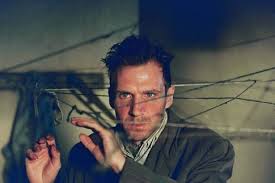
McGrath vs McGrath: Patrick Mcgrath’s "Spider" and the Ralph Fiennes film adaptation that is Totally Not Harry Potter


What do Voldemort, a sock down the trousers, and an intricate series of hooks and pulleys composed of pilfered sting have in common (other than this overwrought comparison)?
Patrick McGrath.

I recently finished re-reading McGrath’s 1990 novel Spider and it was, largely, an enjoyable experience. I say largely, because it has left my language severely disrupted and almost forced me to coin the idiom “pissing spiders”. But the novel itself was excellent, a claustrophobic account of Dennis Cleg (or the Spider of London, as he often wishes to be dubbed). Mid-way through my reading, however, I was made aware that there was Cronenberg adaptation of the novel, staring the dark lord Ralph Fiennes himself. And so it was that, late one fateful Tuesday night, I settled down to watch the adaptation and lost approximately 91 minutes and 17 seconds of my life. Allow me now, dear reader, to steal a few minutes of yours to help you avoid such a fate.

I think my loathing of the Hades remake (anyone else remember Fiennes in Clash/Wrath of the Titans? No?) stems somewhat from my love of the text. Spider involves one man’s recollections of his childhood and the horrors that occurred in his home. We are slowly enveloped in this somewhat eloquent, sometimes charming, but mostly unreliable narration as Dennis Cleg take us on a warped nostalgia trip through the events that drove him to the halfway house where he now resides under the watchful gaze of the tyrannical Mrs. Wilkinson.

Of course I don’t want to spoil some of the more shocking revelations, but ‘your Spider’, as he refers to himself on several occasions, spends the text darting between reality and memory, often depicting events that he was definitely not present to observe. The whole experience is one of unravelling: the reader unravelling the mystery of his predicament; Spider unravelling his story thread bit by bit; and Spider’s own gradual unravelling as the process of remembering slowly drives him back into a form of madness. The story revolves around patriarchal disharmony, an unreliable narrator’s framed narrative, and a perceived revenge tale, and feels distinctly Gothic in tone; it’s hard not to feel Poe in the margins, asking readers if they still think him mad, or to not think of Roderick Usher’s house crumbling into the tarn when Spider visits the blitz-ruined wreckage of his childhood home. It’s an enjoyable read, with subtle nuances towards the twists that keep driving the plot forward.

 
"I feel crazy... oh, so crazy!"

Meanwhile, in the Michael Ebbs version (The Chumscrubber, anyone? 2005? Fiennes plays a mayor? Terrible film, anyway), this subtlety and nuance is lost. Of course, it’s difficult to portray the dual narrative nature of the story (past and present, which McGrath blurs at several points) and the film does actually portray this well.  However, much is lost in the adaptation. The subtle psychosexual implications of Spider’s father killing his mother and replacing her with a prostitute is abandoned as 'Dolarhyde' (everybody loves Red Dragon) recollects his young self watching his mother dancing in a new shift for his father. The film even introduces another new scene in which a young Spider is flashed by Hilda Wilkinson, the aforementioned prostitute, in one of the early memory sequences, foregrounding an issue which is more gradually introduced throughout the novel.

It was also upsetting for a film directed by the Baron of Blood, the King of Venereal Horror, Captain Cronenberg (that’s my own) to not include some of the more interesting moments of grotesquery from the text. Scenes where Spider, for example, finds a baby and sucks its skull dry through a small hole in the top, or the strange sections detailing the warping and twisting of his organs, with his intestines wrapped up his spine, his colon and rectum twisting around his neck and anus showing from the back of his neck. And of course we mustn’t overlook the section in which Spider goes to the toilet and urinates out a thin black stream of spiders into the bowl. All these are abandoned and the film loses something in this. We are still treated to a scene where Hilda throws some of Spider’s Father’s semen into the river, though the camera is interestingly placed so that the audience has this thrown square into their face. Though the idea of this isn’t exactly pleasant, it is still only a mild moment of disgust compared to some of the passages dropped.

Behind the scenes with David Cronenberg

That isn’t to say the film is a complete disaster. The aforementioned section with Hilda and Spider’s father by the river does work incredibly well to show the blurring between Spider and his memories, and to establish the unreliability. Miranda Richardson’s performance in the film is, as always, wonderful, and adds depth to a theme that was purely implicit in the novels. Fiennes pulls off a sympathetic character in this version, but it seems a far cry from the Dennis of the novels. Instead of our confident, but breakable Spider of London, we get a mumbling broken Voldemort (the whole film feels like some strange Potter prequel, damn you Fiennes!), stumbling from a train onto the screen and muttering to himself as he pulls the long sock from between his thighs, an image which loses some of the nuanced sexual implications in the film.

Overall, I’d recommend McGrath’s novel for the immersive nature of the story, for the slow draw into dark implications and genuine concern for a character who charms us while he slips further into delirium, who hides in his own mind as he builds and propagates his own counterfactual narrative world. As Spider puts it himself, “Odd thing, no?”


Novelist Patrick McGrath


If you’d like to know more about pissing spiders, men encased in their own grotesque bodies or doctors trapped within memories then you’re in luck! Stirling University has heard your impassioned pleas to the Gothic Gods and is organising an entire day dedicated to McGrath:

ASYLUMS, PATHOLOGIES AND THE THEMES OF MADNESS: PATRICK MCGRATH AND HIS GOTHIC CONTEMPORARIES is a one day symposium on Saturday the 16th of January 2016, with a cfp out and abstracts due October 16th 2015. For more info, go to http://www.gothic.stir.ac.uk/blog/cfp-patrick-mcgrath-symposium-stirling-january-2016/ and follow the University of Stirling Gothic twitter account at @GothImagination


Danny Southward is a 3rd year PhD researcher at Sheffield University. When not displaying his surprisingly encyclopaedic knowledge of Ralph Fiennes films -[“Anyone else remember he was in the Hurt Locker, too? Madness. And the voice of the hunter dude in Curse of the Were-Rabbit!”]- he can be found pretending not to be thinking about Ralph Fiennes films.