Thursday, 29 October 2015

Samhain in the Great South Land


It is commonly believed that the celebration of Halloween is a uniquely American practice, and, in a certain sense, this is true: it is highly unlikely that the celebration, as we know it today, with its canon of costumes, colours, and commercial impact, would have grown to its cultural reach and significance anywhere else.

When we look back from Halloween to All Hallow’s Eve, the Christian holy day from which its name was abbreviated, or further back to Samhain, the Celtic festival of the dead which preceded both, we see a particular kind of migration. On one level there is the literal migration of the Irish across the Atlantic, and on another, there is the cultural migration which brought their Celto-Christian cultural customs along with them. These customs were then fed on American culture, with the conversion of offerings to deceased ancestors to the beginnings of the practice of trick-or-treating, and the later addition of specific monsters brought into society through the screen by Lon Chaney, Bela Lugosi, Boris Karloff, and others. It is telling that the most iconic of these characters, the Wolfman, Count Dracula, and Frankenstein’s monster, are all also examples of cultural migration, whether from the literature of English and Irish writers or from European folklore, and that the commercialism of these figures through film migrated with the characters into the celebration of Halloween.

Why can’t this mobile and mutable cultural practice travel south? There is a great deal of argument as to its suitability in Australia, much of which is quite justified. Max Fisher suggested that it’s a kind of cultural hangover from the Victorian conservative conditions in which Australia became a nation, which included frowning upon Halloween and other such festivities. He also writes that Halloween is “awfully unseasonal for the South Pacific”. As Jenni Ryall’s article on mashable.com noted, even the pumpkins required for jack o’lanterns would pose a problem. They too are out of season at that time, and frequently the act of “[c]arving an unripe pumpkin can end with a knife wound.” The 31st of October heralds the beginning of spring in the Southern Hemisphere, meaning that the Celts would have celebrated Beltane rather than Samhain at this time if they had happened to have lived in Australia.         

Seasonal scares...
 
Perhaps most of all, the possibility of Halloween fitting into Australian culture is made difficult by the general ambivalence of Australians towards America’s cultural influence upon them. On one hand, it is very much the norm among “true blue” Australians to vehemently deny that American culture appeals to them or has an effect on them. On the other, the filmic diet of most Australians still consists almost entirely of Hollywood films, and Australian actors are often only considered to have made it once they have begun to star in big budget American movies. And they take up American accents in these films – dramatizing a particular variant of the very thing feared in the first place, by choosing to turn themselves into stage Americans rather than forcibly being turned.


There is another way to look at this. If a Celto-Christian festival, which was influenced by the Romans, adopted and altered by the Christians, and looked down upon by the Victorians, can travel across the Atlantic to the United States and have its associated supernatural cast updated according to movie releases and other trends, why can’t it also travel south and have its costume wardrobe adapted once more to new settings? With a wealth of mythological material from the culture of indigenous Australians, the celebration could certainly be developed without necessarily following the well-worn American tracks (despite the willingness of Australian cinema-goers to do so).

 
The Bunyip of Berkeley's Creek (Jenny Wagner and Ron Brooks)

Take the bunyip for example. This monster has played its part in many kinds of tales, from indigenous folk lore to children’s books, and its appearance cannot be narrowed down to one description. Percy Mumbulla describes one such creature being “high in the front and low at the back like a hyena, like a lion. It had a terrible big bull-head and it was milk-white”. The eponymous main character of Jenny Wagner’s classic picture book The Bunyip of Berkeley’s Creek spends most of the story asking other animals what bunyips look like, finally finding out that they have tails and fur. These examples show the bunyip to be suitable for Halloween for two additional reasons: the costuming possibilities are quite flexible and the interplay between the monstrous and the childlike or comical in books such as Wagner’s is much the same kind of dynamic as that of modern Halloween itself.

Halloween has shown itself not only to survive significant changes and cultural appropriations but to actually grow through them, becoming the cultural and commercial juggernaut it is today. Even in the Great South Land, where opposition to the festival is still vocal in some quarters, more and more toy and department stores are beginning to bring out Halloween ranges of costumes and other paraphernalia, and more children each year are seen on the streets of Australian suburbs, ready to knock and call "Trick or Treat!" There will be the usual ghouls and witches in Australian suburbia this October the thirty-first - but there's definitely room for some bunyips too.


Further Reading:

Mumbulla, Percy. “The Bunyip”, in K. Gelder (ed.) The Oxford Book of Australian Ghost Stories. Oxford University Press, Melbourne, 1994. 250-1.

“Why Australians cackle in the face of Halloween”. Jenni Ryall. http://mashable.com/2014/10/30/australia-hates-halloween/#e3qa3W.GnSqz

“How British colonialism determined whether your country celebrates Halloween”. Max Fisher. https://www.washingtonpost.com/news/worldviews/wp/2013/10/31/how-british-colonialism-determined-whether-your-country-celebrates-halloween/

Wagner, Jenny. (story), and Ron Brooks (pictures). The Bunyip of Berkeley’s Creek.


Jason Archbold is a Cotutelle PhD candidate at Macquarie University and the International Graduate Centre for the Study of Culture at Justus-Liebig-Universität. His dissertation explores morals and ethics in apocalyptic fictions. When he is not dodging zombies as part of his research, he can be found investigating cultures through cooking or buried in a mass of comic books.

Tuesday, 27 October 2015

Going 'Over the Garden Wall'


Since we find ourselves once again the greatest season of them all (Autumn, in case you were wondering) and fast approaching that most awesome of holidays (Halloween, obviously) it seems like a good time to talk about a little cartoon called Over the Garden Wall, which first aired on Cartoon Network last November, and released on DVD this September. In my humble opinion, Over the Garden Wall is perfect Autumn viewing: ten episodes of pure, animated, New American Gothic brilliance. OTGW comes from writer Patrick McHale, an Adventure Time alumni behind some of my favourite episodes. Not that I’m biased.

Over the Garden Wall is the tale of half-brothers, Greg and Wirt, who lose their way in the woods and find themselves in a land the show refers to as The Unknown where nothing seems quite right. Over the course of its episodes, they attempt to find their way back home alongside a talking bird called Beatrice and warnings to beware the Beast. Though the premise is hardly original in itself, OTGW treads familiar ground with new and very different feet. Visually, its individuality and attention to detail is extremely engaging and entertaining: Greg wears a teapot on his head, there’s a wolf with LSD eyes and villagers wearing pumpkins. The score and soundtrack are equally excellent- the first episode opens with a frog playing the piano, if that gives you any indication of tone and content:


It’s actually (as I am now discovering after deleting the same paragraph four times) rather hard to describe what’s so wonderful and enthralling about Over the Garden Wall without ruining it. It takes it cues from a number of classic Gothic tropes and conventions- there is the strange small town with their odd Harvest celebration, an aging recluse whose sprawling mansion may be haunted and/or he may descending into madness, and even some instances of demonic possession- the show blends these tropes with humour and twists audience expectations. Like Adventure Time, Stephen Universe, and Bee and Puppycat, OTGW exists in the tradition of a children’s animation at face value, with something much more intricate beneath the surface. I watched the first four episodes swinging between hysterical laughter and goose bumps- the first reveal of the shows shadowy antagonist, the Beast, was probably not the last thing I should have watched before bed. Not that it’s much of an indicator, since I’m a terrible Gothicist and very easily scared.

Originally, I had hoped discuss the way in which the show plays with classic Gothic conventions and audience expectations to create something that is at once an evident product of its genre and something entirely original and unique. But to do that, as I mentioned, I’d have to spoil the show. So I’m going to show some self-restraint and refrain from doing that, and instead use this post as PSA. This autumn, watch Over the Garden Wall. You won’t be disappointed- that’s a rock fact.


Lauren Nixon is a PhD researcher at the University of Sheffield studying gender in the early novel and the Gothic. She loves potatoes and molasses! If you want some - oh just ask us!

Friday, 23 October 2015

Review:'The Spirit of Revision: Lovecraft’s Letters to Zealia Brown Reed Bishop,' edited by Sean Branney & Andrew Leman


There is a common conception of H. P. Lovecraft as the struggling artiste, as an author who refused to compromise his aesthetic vision in furtherance of professional profit. While it is true that Lovecraft did, indeed, consider his work to be on an artistic level far above the majority of work-for-hire pulp authors who published in the same magazines as him, it is also true, though rarely examined, that Lovecraft could be a consummate businessman when the need arose. During the period 1927 to 1936 that need arose regularly, and has been detailed rarely so touchingly as in the remarkable The Spirit of Revision: Lovecraft’s Letters to Zealia Brown Reed Bishop.

There is also a romantic idea, among literary types, of the lost packet of letters discovered against all odds, illuminating the life of one’s chosen author of study. It is this idea that pervades A. S. Byatt’s novel Possession, and it is one of the oldest and most wistful dreams of scholars. For who would not wish to stumble upon a never before seen cache of precious data, and thereby further the common knowledge of our literary ancestors? That the idea is romantic does not mean it is impossible; indeed, it was just such a discovery that allowed the H. P. Lovecraft Historical Society to assemble and publish The Spirit of Revision.

In brief, Zealia Bishop, client and correspondent with Lovecraft, squirreled away her collection of letters and manuscripts in a trunk before her death in 1968. That trunk passed down, eventually, to her great-great-nephew, Sean McCall, who kept it until he happened to meet Will Gautney and Mary Sullivan, guests at his home for Thanksgiving. Will’s Cthulhu t-shirt inspired a conversation about the letters, and he and Mary were allowed to examine them. Mary arranged for them to be shown to, and eventually published by, her friends at the HPLHS. Finds of this sort are not only rare, they may be the pinnacle of one’s lifelong interest in Lovecraftian literature.

If the McCall family never has another discovery greater than this, then the letters contained within The Spirit of Revision will be enough. Here we see Lovecraft from many different angles: we see Lovecraft as a professional, attempting to increase the business afforded him through revision work; we see him as a literary mentor, offering pages of advice on what young authors should read and how they should write; we see him as a friend, spending his scarce free time to reach out to Zelia’s son, James, to encourage him in his interests; and we see Lovecraft’s prejudice, too, speaking proudly of fascism and condemning bookstores who have Jewish owners. The fact of the matter is that Lovecraft, like most people, cannot be reduced down to one or two clearly defined facets of personality. He was complex as well as troubling, and always overwhelmingly generous, kind, and erudite.

The Spirit of Revision is remarkable, then, for showing us as many different facets of Lovecraft as possible, all in a slim, 190-page volume. We have seen Lovecraft’s philosophy and political thought in A Means to Freedom, his letters to Robert E. Howard, and his attitudes towards professional life versus aestheticism in Essential Solitude, his letters to August Derleth. Of the roughly 100,000 letters that Lovecraft wrote in his lifetime, roughly 13,000 or so survive (the number is contested), and only a handful have been published since Arkham House first began publishing the Selected Letters in 1964. How lucky we are, then, that The Spirit of Revision was not only swiftly brought to press, but also done so with a fine editorial hand, eschewing expurgation entirely.

The Lovecraft represented in these letters, the quality of the whole person that I think they show, is similar to the presentation of Lovecraft in O Fortunate Floridian, his letters to R. H. Barlow, and Lovecraft at Last, his letters to Willis Conover, and this volume deserves to stand with those greats. Lovecraft’s epistolary habits lend themselves to verbosity, and the HPLHS have made every attempt to augment his already impressive letters with samples of historical documents relevant to his subjects. Here are pamphlets for the Endless Caverns, next to the letter in which Lovecraft charmingly relays his visit during an antiquarian tour. Here are postcards of areas in Flatbush where Lovecraft lived part time during his estrangement from his wife. And here are recreations of newspapers, detailing the New England floods that helped inspire Lovecraft’s “The Whisperer in Darkness”.

It may be that Lovecraft will, eventually, be better remembered for his epistolary efforts than for his fiction, as S. T. Joshi has asserted. If that is the case, then we will have to hope for more packets of letters, left neglected for decades in trunks, drawers, and closets, until fortune delivers them to the hands of those who recognize them for what they are. If, instead, we have found all that there is to find, then we must be satisfied with the collections that we already have, and attempt to come to know the mind of the greatest author of fantastic literature in the Twentieth Century from the patchwork remainders. No matter the case, however, we should applaud those, such as Sean Branney and Andrew Leman, who edited The Spirit of Revision, who have worked to ensure that what we do have is given to us in remarkable, memorable, and important volumes like this.

The Spirit of Revision: Lovecraft’s Letters to Zealia Brown Reed Bishop was published in 2015, and is available for purchase from the H. P. Lovecraft Historical Society (http://store.cthulhulives.org) for $22.50 USD. Although books have not, as of yet, been a mainstay of the HPLHS métier, this is a fine first entry into a publishing venture. The Spirit of Revision is highly recommended for scholars and fans alike; here we have voices from the past, speaking softly of daily lives long gone, and we should listen. Both to Lovecraft, of course, and through him, his compatriot, the impressive Mrs. Bishop.


Dr. Géza A. G. Reilly has been an avid reader and collector of all things Lovecraftian since he was too young to know better.  Géza received his doctorate in English literature in 2015 and is, to his knowledge, the only scholar of weird fiction ever produced by the University of Manitoba.  An expatriate Canadian, he currently lives in Tampa, Florida with his wife, Andrea, and their cat Mim.

Wednesday, 21 October 2015

Review: Crimson Peak (dir. Guillermo Del Toro)


Ghosts, family secrets, madness, an inquisitive heroine, a disintegrating country seat complete with imposing architecture, fading aristocracy, monstrous machines, glorious costumes, bad weather and HUNDREDS of giant moths – there probably hasn’t been a more self-consciously Gothic film in years. As Mark Kermode points out in his review, Crimson Peak is steeped in the tradition of terror, and Del Toro subverts the Gothic genre even as he luxuriates in its excess.

Part of the Mondo poster, unveiled at Comic Con

The cinematography is superb. Sumptuous imagery of fragile, fluttering moths and butterflies exaggerate the stifling sense of death and decay that hangs in the atmosphere at Allerdale Hall like the thick, English fog that enshrouds it. Spirits dissolve into the air like plumes of smoke, leaving behind an effervescent trace, bound to a particular place or emotion. Haunted topography is central to the conceptualisation of spirits in this film: ghosts function allegorically throughout, as emblems of memory and trauma. They are, as the protagonist Edith explains, 'metaphors for the past'.

The plot adheres fairly closely to the standard Gothic formula: a young woman falls for a charming, mysterious Baronet, regardless of her father’s disapproval and an obscure, prophetic warning from beyond the grave ('Beware of Crimson Peak!'). The American heroine is whisked away to a remote corner of the Lake District to live in her new husband’s crumbling mansion. Enter creepy sister-in-law, who keeps insisting on making endless pots of questionable-tasting tea, because that’s just what British people do when things feel awkward. Several horrifying apparitions later, Edith decides to investigate the forbidden parts of the house and, predictably, she uncovers a few skeletons in the family closet.

Lady Lucille Sharpe: part Mrs. Dancers, part Bertha Mason. Proud owner of the ultimate 'resting bitch face'

There are shades of Walpole, Radcliffe, Poe and the Brontes here, but also a nod towards more contemporary Gothic texts, such as Virginia Andrews's claustrophobic Flowers in the Attic. Even the protagonist's name, Edith Cushing, may be a subtle reference to the late and great legend of Hammer Horror, Sir Peter Cushing. Perhaps that's a bit of a stretch, but this is a Gothic film by a director who knows his Gothic, so there are surely no coincidences!


Crucially, Edith is not your average Gothic heroine. She may look like a classically Radcliffian damsel with her flowing locks and fluttering nightdress, but Del Toro wastes no time in demonstrating that she is anything but an archetype. An aspiring novelist, Edith is denied the right to be taken seriously as a female writer in the late-Victorian publishing industry. When compared to ‘spinster’ Jane Austen by an odious socialite, Edith remarks: ‘Actually, I’d rather be Mary Shelley. She died a widow’, which highlights Del Toro’s absolute engagement with the Gothic tradition. Furthermore, she takes great pains to dissociate herself from perceived sentimentality, resolving to type out her manuscript on her father's typewriter, lest her handwriting prove ‘too feminine’ in the eyes of her critics.

Speaking of eyes, there is a recurring motif of seeing and not seeing in Crimson Peak: things that lurk just out of sight, waiting to appear ‘when the time is right’. Early photography is introduced at various moments in the narrative to remind us that we are never seeing the full picture. A still image of the past does not tell the full story, but a gramophone might...


Like all gifted filmmakers, Del Toro understands the pivotal role of sound in the art of instilling fear. Allerdale Hall seems to come alive with an eerie orchestra of sounds, some human, some less so: rustling moth wings, violent gusts of wind, mournful piano rhymes, clanging water pipes, the whir of industrial machinery, creaks and groans as the house sinks deeper into the ‘Profondo Rosso’ clay (hence the title of the film) - all of these amalgamate to form a cacophony of noise that accompanies Fernando Velazquez's haunting, wistful score.

Like the blood-red earth that seeps through the floorboards of the Sharpe household (themes of nature reclaiming space and the dissolution of aristocracy) Crimson Peak leaves behind a vivid stain that will haunt your thoughts long after the credits roll. This film sees Del Toro making a triumphant return to what he does best and the handful critics who complained about the lack of ‘scare factor’ have clearly missed the point. As Edith suggests at the very beginning: it is not a ghost story, but a story with ghosts in it. Crimson Peak is not a straightforward horror movie, but rather a collage of familiar Gothic motifs with added depth and modernity. A decade after his critically-acclaimed fairy-tale Pan’s Labyrinth, Del Toro presents another masterclass in Gothic cinema that is enchanting and disturbing in equal measure. And if this doesn’t convince you to see Crimson Peak immediately, then this picture certainly will:

YES!!! ALL THE YES!!!


Carly Stevenson is a PhD researcher studying Gothic literature and poetry at the University of Sheffield. She is currently wandering around a haunted mansion looking for ghosts and/or Tom Hiddleston...

Monday, 19 October 2015

Review: 'The Starry Wisdom Library: The Catalogue of the Greatest Occult Book Auction of All Time' by Nate Pedersen (Editor)


It has always been in the nature of weird fiction (whether we are discussing historical weird fiction, the Lovecraft Mythos, or the Cthulhu Mythos) to treat texts as containers of semantic meaning. That is, texts (usually old, moldering manuscripts written by devotees of forgotten titans) are considered to possess an ontological relationship with the world around them – they both describe things-as-they-are and are those things-as-they-are at the same time, with no necessary distance between “existence” and “sign.” This tradition has persisted over the decades since Robert W. Chambers created the decadent play The King in Yellow and H. P. Lovecraft (however unknowingly) followed up with the awful demonology The Necronomicon. Recently, certain scholars have argued that we should accept the possibility that the dread tomes of weird fiction are not, in fact, containers of semantic meaning, and that there is every possibility that The Necronomicon et al. are incorrect or ill-informed. However, the myth of the malicious manuscript still persists in the fiction – often to our great delight.

It is with that sense of delight that we should receive The Starry Wisdom Library: The Catalogue of the Greatest Occult Book Auction of All Time (PS Publishing, 2014), which is perhaps the most unusual anthology of weird fiction I have ever come across. According to the introduction by S. T. Joshi (here represented as a librarian from Miskatonic University), the book is a recently discovered artifact of the Church of Starry Wisdom (created by Lovecraft and used in his 1935 “The Haunter of the Dark”). As the subtitle suggests, the book purports to be the catalogue of an auction organized by the firm of Pent & Serenade in 1877 – the year of the Church’s disbanding. Each section of the anthology maintains that conceit by presenting the catalogue entry for a specific text (such The Seven Cryptical Books of Hsan, Thaumaturgical Prodigies in the New English Canaan, or The Necronomicon itself), separated into bibliographic specifics (written for each by Jonathan Kearns) and a vignette of the history of the text in question (written in a scholarly manner by that entry’s author).

Naturally, the entries within The Starry Wisdom Library are pure fiction, but their success at presenting as close to a real-world catalogue as possible renders it understandable why a casual reader might mistake them for the actual thing. This is not the first volume to make an attempt at a realistic portrayal of such a catalogue – Joan C. Stanley’s Ex Libris Miskatonici has been well reviewed, but is now a collector’s item – but it is perhaps the most extensive at its deception. It is interesting to note that the various authors do not all approach their subjects in the same manner. Although many (apparently) buy into the conceit that the texts up for their review are containers of semantic meaning, and therefore dangerous to their readers, others take radically new approaches to the concept of the forbidden tome. Nick Mamatas’ entry, for example, brilliantly rejects any reading of The Black Book of the Skull that hinges on the text having a metaphysical or supernatural truth inspiring its writing. This variety in composition compensates for the uniformity of presentation, although it must be said that the presentation will cause many reader’s eyes to glaze over after a prolonged reading session.

Who you gonna call?

A word needs to be said about the physical makeup of The Starry Wisdom Library, which adds a substantial amount to the verisimilitude of the text. An incredible amount of detail was paid to the design of this slim, 176 page volume, which was done by Andrew Leman and complemented with six internal prints by Liv Rainey-Smith. Everything from the language used, to the font deployed, to mock “Conditions of Sale” and “Bid Sheet” auction pages, to the summaries of lots and contributors’ careers, goes towards the convincing aspect of the whole. Not only is the physical makeup realistic, it is also handsome; available in hardcover for £20 directly from PS Publishing ($35 USD on Amazon), The Starry Wisdom Library is cleanly bound, with an attractive dustcover and beautiful faux-marble endpapers. This is one of the most beautifully designed weird fiction anthologies I have ever encountered, and Leman’s work makes the whole a treat to read above and beyond the quality of the contributors’ writing.

Anyone familiar with any of the various strands of weird fiction should be familiar with the trope of the forbidden tome. “Books can be harmful,” the trope tells us, and furthermore, “books are true things.” The Starry Wisdom Library is not true, it is certain, but it points us towards the tragedy of the nature of signs, and argues for a deeper horror than some of the more tired clichés of the Cthulhu Mythos: that there is no understanding anywhere, nor is any possible. The fictitiousness of The Starry Wisdom Library reminds us that the texts within, and thus their status as containers of semantic meaning, are impossibilities. Signs can only refer to other signs (or so the theory goes), and not to an external world. The grimoires, demonologies, philosophic treatises, and holy texts in The Starry Wisdom Library cannot, therefore, point towards anything “real.” They can only remind us that if texts could, we might be unmade by our own acts of reading.

The Starry Wisdom Library is currently available, and has seemingly made shockingly little impact. It deserves to make much more, however, and I heartily encourage bibliophiles, scholars, role-playing game aficionados, and fans of weird fiction to consider ordering a copy. I suspect that an anthology of this kind will not come around again for some time, and even if it does I cannot imagine that it will have the same attention to detail, excellent design, and overall love of subject matter that this one does. Without a doubt, The Starry Wisdom Library will come to be a centerpiece of many a collection, and I would not be surprised to find it listed as a collector’s item in just a few short years.


Dr. Géza A. G. Reilly has been an avid reader and collector of all things Lovecraftian since he was too young to know better.  Géza received his doctorate in English literature in 2015 and is, to his knowledge, the only scholar of weird fiction ever produced by the University of Manitoba.  An expatriate Canadian, he currently lives in Tampa, Florida with his wife, Andrea, and their cat Mim.

Friday, 16 October 2015

Forshadowings: Religious Gothic and 'The Monk' by Matthew Lewis


Last week, Sheffield Gothic had its first meeting of the new semester, screening the 1947 film Black Narcissus, based on Rumer Godden's 1939 novel of the same name. It was a brilliant film about madness and desire in an isolated convent full of troubled nuns. Afterwards we discussed surveillance within convent life and how the film's gendered and political discourses reflected the post-WWII world. Mental illness and the resurrected and returned past were also important elements discussed in a Gothic context. Most notably, the unusual aesthetic of the piece made it stand out among the other Gothic materials we've read and watched – rather than depicting shadows and obscurity, this film was shot in a stark and bright yet dream-like space on the top of a mountain, and numerous characters complain of being able to see to much of themselves and their surroundings rather than too little. 

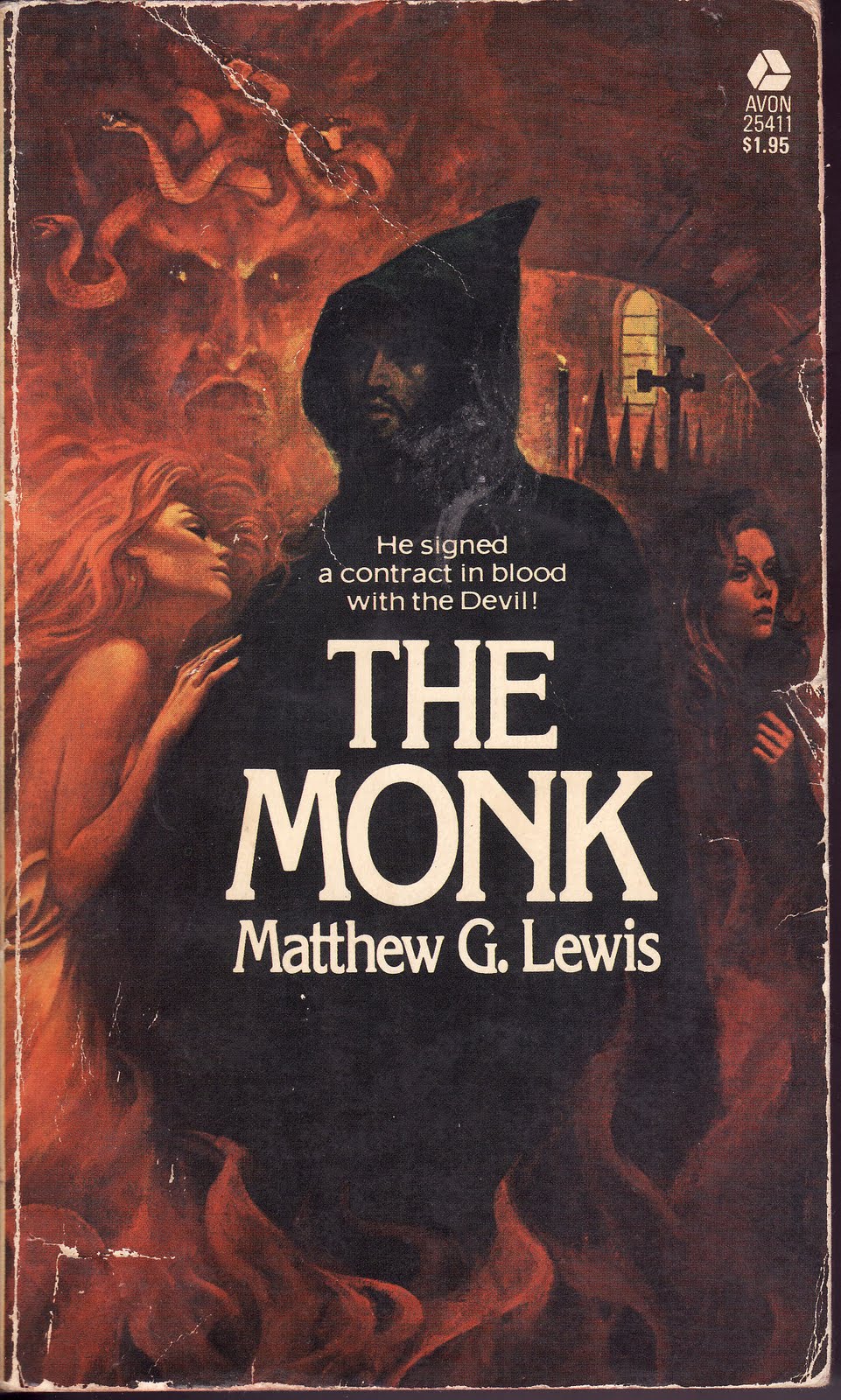
 In our next reading group meeting we will be going back to the early Gothic genre to discuss Matthew Lewis’s infamous 1796 novel The Monk. This work employs a more traditional Gothic aesthetic and is considered a formative text among Gothic students. The story follows a troubled, repressed monk as he struggles within a hypocritical system of morality and eventually falls prey to demonic forces.

Early Gothic novels are particularly relevant to our semester's 'Religious Gothic' theme (plus the novel is named 'The Monk' so... there's that). The first examples of Gothic novels emerged during a time when many British authors were trying to redefine their of national literary identity. One of the strategies for this was aligning ‘Britishness’ and national identity with a Protestant morality as opposed to a Catholic (French / Italian) 'otherness' and a pre-Enlightenment preoccupation with superstition. For example, heroines in Ann Radcliffe’s novels, while ostensibly foreign, represent an ‘English’ / Protestant belief system which finds itself trapped in a dangerous, alien, and nominally Catholic culture. The heroine's evolving 'sensibility' suggests a rational emotional intelligence which rejects a blind belief in the supernatural and the corresponding inability to respond maturely to 'terror'.

 
"...and this one time, at band camp..."
"Please stop..."

Matthew Lewis wrote The Monk as a response to, and a deviation from, Radcliffe's work, and in keeping with his 'masculine' Gothic style tends to be more preoccupied with overt ‘horror’ than the nuances of ‘terror.’ Maggie Kilgour argues that “Lewis presents himself as the complete revealer, who takes all of the terrors that Radcliffe leaves submerged and exposes them, turning gothic potentials into reality” (The Rise of the Gothic Novel, 142). He creates worlds where identity is fluid and anything is possible, and as such established institutions and religious and political and class identities are destabilized, exposed as inadequate, hypocritical, or corrupt. Rather than advocate for one religion or national discourse over another, Jacqueline Howard argues that Lewis uses discourses of sublimity to “describe a world in which there is no universal rational and moral order” (Reading Gothic Fiction, A Bakhtinian Approach, 219). Such narrative is a significant Gothic alternative suggesting a libertine discourse which sees all institutions, including religious institutions as represented by monastic hierarchies, as inherently problematic.

As such, organized religion becomes the mechanism through which Gothic monsters and grotesques are made. The titular monk Ambrosio's better traits are twisted within a repressive monastic system, leaving him open to seduction by a demonic temptress. A man attempts to elope with his love despite her commitment to become a nun. He is later entrapped by the ghostly ‘Bleeding Nun,’ who drains him of life and is only banished by the intervention of the ‘Wandering Jew.’  A prioress of a convent attempts to murder deviant nuns, a monastery tomb becomes the scene of a horrific rape and murder, and ultimately both the monastery and convent are destroyed by a raging mob.

Still... beats the morning commute! Am I right? Anyone...?

By the time we learn that one overbearing mother character has forbidden her daughter from reading the Bible - “ convinced that, unrestricted, no reading more improper could be permitted a young woman, and that “the annals of a brothel would scarcely furnish a greater choice of indecent expression” - one is, surprisingly, forced to concede some truth in the mother's ironic fears (Lewis, 191). Most of the text up to that point has suggested that religion nurtures vice and corrupts virtue, at best failing to provide an adequate moral compass, at worst imposing arbitrary restraints and denying free human emotion with mortal consequences. 

But is the novel really that straightforward? What is Lewis really trying to say about organized religion? How do religious tropes define the characters and their actions? How does Lewis use religion to construct the 'Gothic,' and how does the 'Gothic' influence our understanding of religion and identity? 

Come to Gothic reading group for more discussion, cake, and death! We'll be meeting on October 21st, 4-6 pm, and the University of Sheffield (JW, Hub 2).  Follow us on Twitter @SheffieldGothic for more updates!


Kathleen Hudson is a final year PhD student studying servants in early Gothic literature at the University of Sheffield. She has a desk Cthulhu...and it's adorable.

Wednesday, 14 October 2015

Review: 'The Rise, Fall, and Rise of the Cthulhu Mythos' by S. T. Joshi


To understand The Rise, Fall, and Rise of the Cthulhu Mythos, we must consider previous book-length treatises on the work and legacy of H. P. Lovecraft. In 1972, Lin Carter published Lovecraft: A Look Behind the Cthulhu Mythos, which was a weak, but nevertheless charming, discussion of Lovecraft’s influence. However, Carter’s work was marred by his devotion to the specious theories of August Derleth, friend to and publisher of Lovecraft, which were ascendant at the time. Although Carter’s views on the Cthulhu Mythos went out of fashion along with Derleth’s, it would be decades before anyone sought to assess the genre in another book-length work.

 
Lost in the Cthulhu Mythos

Enter S. T. Joshi’s The Rise and Fall of the Cthulhu Mythos (Mythos Books, 2008), which was the culmination of much wide-ranging reading and thought on the subject of the Cthulhu Mythos – a genre which grew (perhaps parasitically) out of Lovecraft’s work. An insightful tirade on what is wrong with a popular genre, Joshi’s The Rise and Fall was a critical attack on the common structures found within weird fiction since the 1920s. In brief, Joshi critiqued the manner in which authors of the Cthulhu Mythos deviated poorly from the principles espoused within what he termed “the Lovecraft Mythos”, and suggested that the genre that followed Lovecraft had largely come to an undignified end.

In 2012, John D. Haefele published A Look Behind the Derleth Mythos, which served as a follow-up to Carter’s and Joshi’s texts. The book, which was published in a revised and expanded form in 2014 by The Cimmerian Press, was one of the few times that anyone has put forward extensive support and analysis of August Derleth’s theories since the 1970s. Haefele took especial umbrage with Joshi’s arguments, most notably those levelled in The Rise and Fall, and challenged those arguments to greater and lesser success throughout. Although there was much of interest in Haefele’s work, it would be an understatement to say that it has not been well regarded within weird fiction criticism.

Recently, Joshi has published a revised and expanded text titled The Rise, Fall, And Rise of the Cthulhu Mythos (Hippocampus Press, 2015). Joshi’s purpose for writing this new version seems clear: he wants to address “the extraordinary burgeoning of Mythos writing that has occurred in the past decade” (8), and he wants to rebut Haefle’s criticisms. Unfortunately, the expanded sections of The Rise, Fall, and Rise do not amount to anything particularly weighty. To get Haefle out of the way, Joshi has added ten pages to his sixth chapter, which is specifically concerned with the additions and obfuscations August Derleth put upon Lovecraft’s work. Although Joshi addresses at least some of Haefle’s concerns, it must be said that Joshi seems unnecessarily pejorative throughout this section, which threatens the weight of his criticism. Somewhat oddly, the sources for The Rise lists only the 2012 edition of Haefle’s book; however, Joshi’s introduction is dated to 2014, suggesting that he simply was not aware of Haefle’s expanded text during composition.


In the tenth and final chapter of the book, “Resurgence” (which is unique to this edition), Joshi addresses new Mythos writing. However, some (albeit only a minority) of the chapter is made up of the same material found in the ninth chapter of his earlier edition. As elsewhere, Joshi claims to use “widely accepted literary principles” (12) to render judgment on the various works up for examination in this chapter, but I fear that he rarely does the actual legwork of showing how or why a work is or is not worthy of our attention – and this lack of a central aspect of literary criticism is, I think, the biggest flaw in Joshi’s otherwise impressive oeuvre. Too often, Joshi descends into hyperbolic expressiveness in order to convince us that a given work is not all it could be (as when he begins summarizing the plot of Basil Copper’s The Great White Space with “To make a long, tedious, boring story short” [282], without demonstrating why the novel is overly long, what makes the plotting tedious, or why the prose is boring), and this hampers his impact. Strangely, Joshi is just as hyperbolic about his own The Assaults of Chaos (Hippocampus Press, 2013), which, while not as excellent as his scholarly work, is nevertheless an entertaining novel.

I am ultimately uncertain as to why this book exists. The light revisions of both text and citations throughout (citations of Lovecraft’s revision stories strangely refer to an anthology that has not yet been released), and the addition of no more than perhaps fifty pages of new material, hardly seems worthy of issuing a second edition of what was a flawed, but still noteworthy, book. Joshi has not substantively changed his opinions, after all; he still dislikes pastiches of Lovecraft’s work, he still believes that there are some few worthy contributions to the Cthulhu Mythos being made, and he still believes that August Derleth should be written out of the history of Lovecraftian fiction. Both the 2008 and 2015 edition of Joshi’s text rests on these conclusions, and a few dozen new pages on new fiction and old criticism does not, it seems to me, justify a whole new issuing of the text.

If one is unable to locate a copy of the physically superior hardcover Mythos Books version of The Rise and Fall of the Cthulhu Mythos, or if one is a scholar or collector of this sort of criticism, then by all means pick up the softcover Hippocampus Press The Rise, Fall, and Rise of the Cthulhu Mythos. But if one already has a copy of the 2008 edition, I cannot in good conscience recommend paying $25 USD for what is little more than a reskin of an edition that is less than ten years old. Make no mistake: Joshi is, indeed, the pre-eminent Lovecraft scholar, and a keen critic of weird and horror fiction in general. But here he is in essence repeating what he has already said before.


Dr. Géza A. G. Reilly has been an avid reader and collector of all things Lovecraftian since he was too young to know better.  Géza received his doctorate in English literature in 2015 and is, to his knowledge, the only scholar of weird fiction ever produced by the University of Manitoba.  An expatriate Canadian, he currently lives in Tampa, Florida with his wife, Andrea, and their cat Mim.